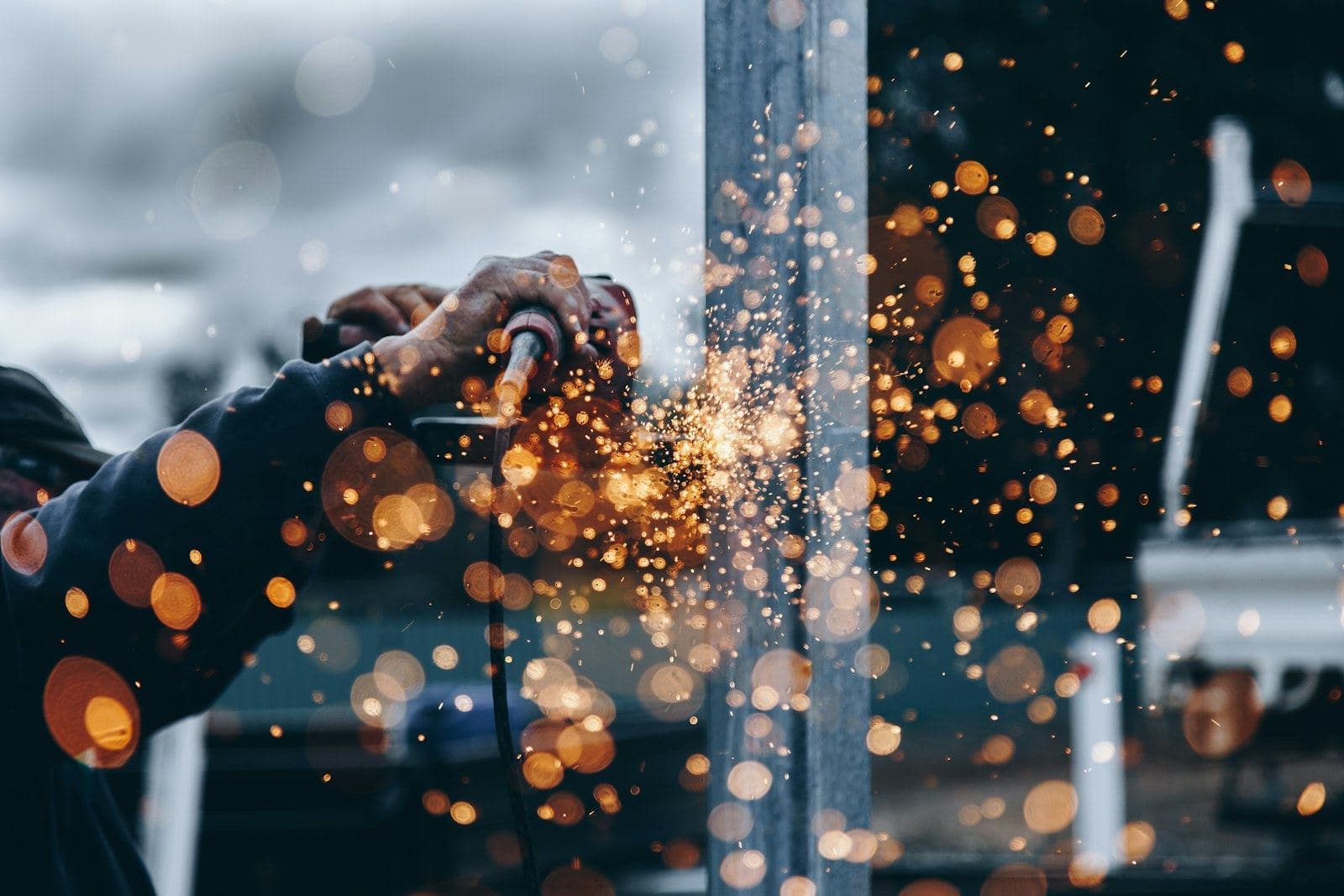
Reading the forge the way the master does
Thermal vision and acoustics at the press, trained on the forge master's own calls, so an off-temperature billet is flagged before it is struck.
- Reference design
- Forging
- Computer VisionEdge AIIndustrial IoTVoice Capture
- Edge: Jetson Orin, thermal + RGB camera, contact mic. Works offline.
- Furnace PLC (Modbus), WhatsApp alerts, shift report PDF
It lives in the head of the forge master.
He reads steel by colour, by the ring of the first blow, and by how the flash spreads. He rejects a billet in under a second. He cannot write down why, and nobody has asked him to.
- Radiant heat, scale and vibration at the press.
- Cycle time of a few seconds per part. No time for a screen.
- Operators do not read English. Alerts must be a light, a sound, or Gujarati voice.
- Unreliable internet on the shop floor.
- 01
Instrument the press
A thermal camera watches the billet leave the furnace. A contact microphone listens to each blow.
- 02
Record the master's calls
Every accept, reject and re-heat he makes is logged with one button and an optional Gujarati voice note.
- 03
Learn his threshold
An edge model links the thermal profile and blow acoustics to his decisions, per die and per grade.
- 04
Flag before the strike
Off-temperature billets trigger a stack light at the press. The master overrides; the override becomes a label.
- Fewer under-heated strikes, so less die wear and fewer laps and cracks.
- Newer operators get the master's threshold as a light, not a lecture.
- A shift report of temperature spread per die, without a clipboard.
A record of what the master saw, heard and decided, blow by blow, so the system keeps learning his calls.
- D1Thermal video of each billet from furnace door to die
- D2Hammer-blow acoustics, time-aligned to the frame
- D3The master's accept / reject / re-heat label per billet
- D4Gujarati voice notes transcribed against the part
- D5Die, grade and furnace setpoint context from the PLC
Recorded on site and owned by the plant. The system uses it to keep learning your floor.
- 01
Capture
Thermal + RGB camera, contact microphone, one-button label box
- 02
Edge
Jetson Orin: frame sync, temperature estimate, acoustic features
- 03
Model
Per-die classifier trained on the master's labelled decisions
- 04
Record
Local store, synced when online: video, audio, labels, PLC context
- 05
Surface
Stack light at the press, WhatsApp alert, daily shift report
Agreement between the model and the master's calls.
PILOT MEASUREMENT REQUIRED: agreement rate over four weeks of labelled billets.
Fewer defects traced to billet temperature.
PILOT MEASUREMENT REQUIRED: lap and crack rejection rate before and after.
The model keeps learning the master's calls.
PILOT MEASUREMENT REQUIRED: labelled billets per month and model agreement over time.
Run a plant with an expert like this?
Tell us whose judgement your floor cannot run without. That is where a pilot starts.